Your business is growing. Your operations haven't kept up.
You're the fallback for everything
Approvals, exceptions and chasing all route back to you, because no one else has the full picture of how the work is supposed to run.
Execution is inconsistent
Projects stall, deadlines slip, and no one owns follow-through. Your team is capable but lacks the structure and leadership to execute reliably.
Processes and tools don't scale
What worked at 5 people breaks at 20. Workflows are manual, tools are disconnected, and the operational infrastructure hasn't caught up with the business.
You want to exit, but you've never prepared for it
Buyers don't just look at revenue. They look at how the business runs without you. Without clean operations, documented processes, and a team that executes independently, you won't get the valuation your business is worth.
Four connected areas
Process, systems, ownership, and cadence: what decides whether finance-related work keeps moving without you.
Process
Map the recurring workflows, simplify the steps, and document the improved process so it can be followed by someone other than the person who invented it.
What this includes
Improve approval, purchasing, and payment workflows
Write the SOPs and recurring checklists the work depends on
Remove steps that exist only because they always have
Systems
Clarify where each piece of information belongs and reduce the duplicate entry that comes from systems that do not talk to each other.
What this includes
Connect CRM, delivery, billing, and accounting information
Agree one source for each figure, and where the others read it from
Build an implementation roadmap for the systems that need changing
Ownership
Define who performs each step, who reviews it, who approves it, and who follows up when it stalls.
What this includes
Create responsibility matrices for recurring finance work
Set approval thresholds so work does not wait on one person
Track finance-related vendors, renewals, and compliance obligations
Cadence
Establish the recurring reviews, scorecards, and issue tracking that keep the work moving without someone chasing it.
What this includes
Build finance and operating scorecards
Set the recurring review rhythm and who attends
Track open issues to closure rather than to the next meeting
Project-based or ongoing, your choice
Every engagement starts with understanding where you are. From there, we scope the right model for what you need.
Project-Based
Scoped. Fixed price. Defined outcome.
Best when you have a specific problem to solve: a process that needs redesigning, a tool that needs implementing, or a systems audit that needs doing. We scope it, price it, and deliver it.
Clear scope and fixed price agreed upfront
Defined deliverable and timeline
No ongoing commitment required
Can transition to monthly support after delivery
Typical projects
Process audit and redesign · Tool selection and implementation · SOP documentation · Systems integration · Exit readiness prep
Operations Monthly
Embedded. Ongoing. Hands-on.
Best when the workflows need continued attention: keeping owners, approvals and cadence current as the business changes, and improving them as new problems surface.
Dedicated ops lead embedded in your business
Fixed monthly fee, no long-term contract
Scale scope up or down as needs change
Covers all four pillars as priorities evolve
What's covered each month
Weekly check-ins · Process and systems work · Team coaching · Strategic planning support · Tool management · Ongoing execution
Not sure which fits? We scope every engagement individually. Tell us where you are and we will recommend the right model.
A short call to understand your current operations, vendors, and the work slowing you down. We review what's in place, then send a scoped proposal with a fixed price.
2
Kickoff
Align the plan
Walk through your scoped proposal, introduce the team, and align on first-month priorities and the operational baseline.
3
Audit
Map and prioritize
Map current workflows, vendors, and tooling. Identify the highest-leverage fixes and design the operating cadence.
4
Embed
Run and improve
Execute on the roadmap, owning vendor coordination, process improvements, and team rhythm. Monthly reporting, quarterly priorities.
Your operation, documented and running
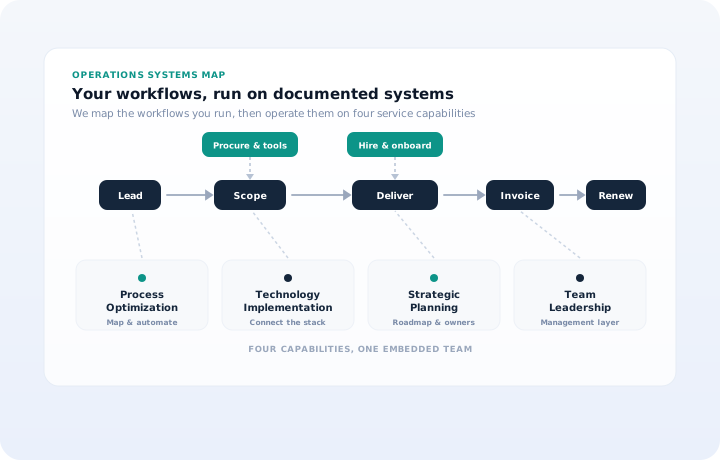
Mapped processes, a connected tool stack, and documented SOPs, so the business runs on systems instead of on you.
What you receive depends on the scope we agree together. This is a typical shape, not a fixed list.
Example of the process and systems map we build, illustrative.
What operational support looks like in practice
Two situations this service is built for, and what the work involves.
SaaS · growth-stage
Every finance question routes back to the founder
Situation
Billing, collections and payment approvals all route through the founder, because nobody else knows what the process is meant to be. Nothing is documented and no one owns a step end to end.
What the work involves
→Define who owns each recurring finance-related workflow, and what each step needs
→Document the billing, collections and approval processes as they should run
→Set approval thresholds and access so work does not stall waiting on one person
→Establish the cadence that keeps the process current as the business changes
Professional services · defined project
Systems that do not agree with each other
Situation
Billing, the accounting system and the project tool each hold a different version of what was delivered and what was invoiced, so reconciling them is manual and the numbers are questioned every month.
What the work involves
→Map how information actually moves between the systems today
→Agree one source for each figure, and where the others take it from
→Connect or consolidate the systems only where the current setup cannot support the work
→Document the reconciliation so it is a check rather than a rebuild
Common questions
Can you improve a workflow without replacing our current systems?
Yes. We start by clarifying the process, who owns each step, and what information it needs. A system change is recommended only when the setup you have cannot support the work effectively.
Is this a fractional COO service?
No. Operational Support focuses on the workflows and systems that produce financial information or affect financial execution. That may include billing, collections, purchasing, approvals, recurring finance tasks, compliance tracking, or implementations tied to the finance function. It is not ownership of company-wide management, organizational design, team coaching, or every operating function.
How does this work alongside your finance services?
Operations and finance are naturally connected. Planning, headcount, tooling decisions all flow through both. Many clients take both services together, which means a single team understands your business end to end. You can also engage operations support independently if your finance function is already running well.
How quickly can we start?
Most engagements up and running in days, not weeks. We start with a focused diagnostic, understanding your team, your current processes, and the biggest constraints on execution. There's no long ramp-up or consulting deliverable phase before real work begins.
Do you write reports and hand them off, or do you actually do the work?
We do the work. We're not a consulting firm that produces decks and leaves. We embed in your business, run the meetings, build the processes, implement the tools, and manage the execution, alongside your team, not above them.
What industries do you work with?
We work primarily with service businesses, professional services firms, SaaS companies, and agencies, typically founder-led with 5 to 100 employees. If you're growing, operationally complex, and the founder is still wearing too many hats, this engagement model is a good fit regardless of sector.
Can you work with a team that's already overwhelmed?
Yes, that is usually when we are most needed. We do the operational work directly so we are reducing your team's load, not adding to it. Onboarding is light: a kickoff call, access to the systems we will work in, and we take it from there. You should not need to dedicate a full-time person to managing us.
Do you require us to switch tools?
No. We work with whatever stack you already use, project management, CRM, communication, HR, finance tools. If we identify a tool that's actively blocking progress or duplicating work, we'll flag it and explain why, but the decision to switch is always yours. We're not tied to any vendor.
How do you measure success?
We agree the success criteria with you before we start, scoped to your specific engagement. Common ones include: process documented and running without founder input, SOPs in place for the top 5 to 10 critical workflows, time-to-onboard a new hire reduced, and clear ownership for every recurring operational task. Concrete deliverables, not vague outcomes.
Do you have a minimum engagement length?
Project-based engagements run as long as the scope requires, with the duration agreed upfront. Retainer terms are confirmed in your proposal. We aim to deliver visible progress early so you can quickly see whether the engagement is delivering value.
Do you handle the accounting side too?
Yes. Operations and finance are run by one senior team, pair this with Fractional CFO, Controller, or Accounting support so your systems and your numbers stay in sync.
Build clearer workflows and more reliable information.
Clearer workflows, clear ownership, and information you can rely on. We reply quickly.