Turn performance, cash, forecasts, and operating plans into clear insight for hiring, pricing, spending, financing, and growth decisions. The strategic finance seat, without the full-time hire.
Understand what the numbers mean, what is likely to happen next, and how a decision could affect the business before you commit.
These are the moments that prompt founders to engage a fractional CFO. If more than two apply, you're past due.
"We're close to a fundraise and investors want a model. Nobody on the team has built one before."
Founder, SaaS
"Revenue is growing but cash is always tight and I can't explain why."
CEO, E-Commerce
"The reports arrive every month. Nobody tells me what changed, or what I should do about it."
CEO, Fintech
"We don't have a real budget. We just spend and hope the bank account doesn't go red."
Founder, Services
"An acquirer asked for three years of clean financials and a financial narrative. We had neither."
CEO, Software
"We just raised, and the board now expects monthly reporting we don't produce yet."
Founder, SaaS
Questions your CFO helps answer
Pick the one you are asking right now.
What your CFO does about it
How are we performing against the plan?
Connect actual results to the forecast and explain the important differences, so a number that moved comes with the reason it moved.
What the financial model covers
The model isn't only for fundraising. It is the tool your CFO uses every month to track performance, stress-test decisions and keep leadership aligned on where the business is heading.
Revenue and ARR
Revenue projections built around your actual drivers: pricing tiers, conversion rates, churn and expansion.
Unit economics
CAC, LTV, gross margin and payback period tracked as the business scales, for internal decisions and for investor questions.
Burn and runway
Cash position modeled against spend plans, so you know when you need to raise, cut or accelerate with time left to act.
Hiring and headcount
Headcount scenarios tied to revenue milestones, so hiring decisions have a financial basis rather than an instinct behind them.
Scenario planning
Base, upside and downside cases built and maintained, so when something changes you already know the implications.
Scenario models, runway and the assumptions behind them, so a board or investor conversation starts from numbers you trust.
What an engagement includes depends on the scope we agree. This is a typical shape, not a fixed list.
Insight stays current between meetings
Relevant reporting, forecasts, priorities and commentary can be organized in the Finsightic portal based on the engagement. The portal keeps the information accessible. Your CFO provides the interpretation, judgment and discussion that turn it into a decision.
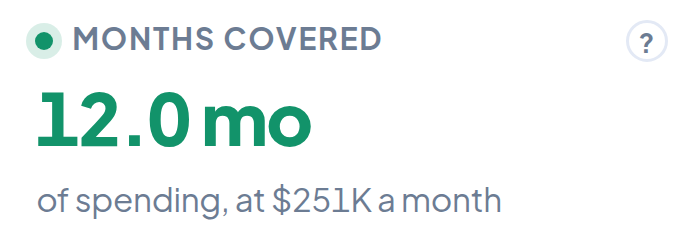
Cash on handOperating cash only. Reserves and anything already promised sit outside this number, so it is what you could actually spend this week.From the bank, tied back to the balance sheet at the close.
Net cashWhat the business adds each month after everything, including the months payroll runs three times. One unusual month does not move it.Money in less money out, from the closed accounts.
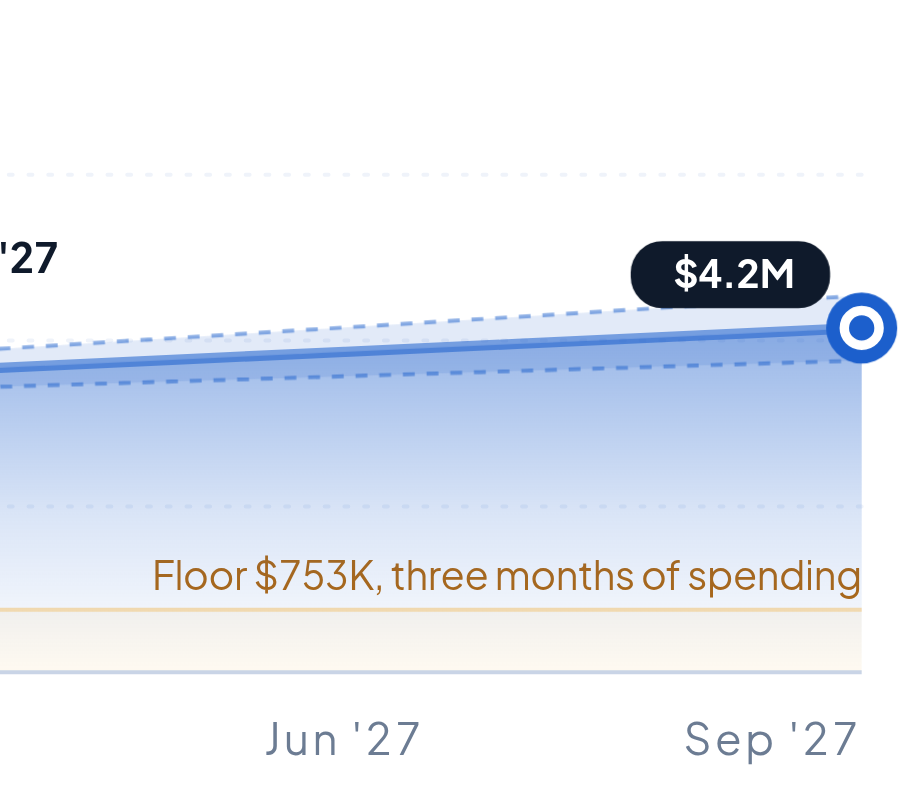
In twelve monthsAt the pace you are running now, with nothing new bought and nothing new raised. It is a starting point for a decision, not a promise.The projection carried forward at the current net.
The line, back and aheadSolid to today is cash you actually held at each month end. The band after it, not the line, is the forecast: it shows where cash lands if the pace runs a third slower, which is the case that decides whether you hire in the first half.The closed months are read from the accounts; the months ahead are drawn from the net you are running now.
The client portal, shown with sample data.
Oriented quickly, priorities set from day one
We establish your financial baseline, reporting framework, and model before moving to ongoing advisory work.
1
Phase 1
Orientation & baseline
Systems review, books assessment, and financial baseline established. We identify what exists, what's missing, and what needs to be built.
2
Phase 2
Model & reporting
Financial model built, forecasts structured, and board reporting framework established. Reporting is investor-ready before the first board meeting.
3
Ongoing
Monthly advisory
Updated forecasts, variance commentary, dashboard, and a 60-minute strategic call each month. Between calls, your CFO is available for decisions and ad hoc support.
4
As needed
Fundraise support
Investor modeling, data room preparation, and due diligence support when a raise is underway. Structured so the CFO is already embedded before diligence starts.
Many clients engage us shortly after closing a round. The first priority is typically getting board reporting in place and connecting financial systems. We scope the full engagement, cleanup if needed, controller layer, and CFO work, so everything is operational before the first board meeting.
What you receive, and what each part answers
Scope is agreed before work begins, so not every engagement includes every item. Grouped below by the question each one is there to answer.
Seeing where you stand
›Cash and runway reporting
›Budget versus actual analysis
›KPI and unit economics reporting
›Relevant portal views
Deciding what comes next
›Rolling forecasts and scenarios
›Hiring and headcount planning
›Regular leadership meetings
Answering people outside the business
›Board or lender reporting
›Financing and diligence support
CFO engagements in practice
Two situations this service is built for, and what the work involves.
SaaS · preparing a raise
Preparing for investor questions
Situation
A company preparing its first institutional round with no financial model and no board package, where leadership had not run a raise before and investors were asking questions the team could not answer.
What the work involves
Build a three-statement model with the metrics investors ask about, assemble the data room, and run board reporting through diligence. The CFO can stay engaged afterwards for ongoing board work.
Professional services · new investor
Board reporting built from nothing
Situation
A services business that has taken on a strategic investor, where the investor expects quarterly board reporting and variance commentary the team has never produced.
What the work involves
Design the reporting template, build a project-level profitability model, and prepare the board package. The CFO can run the quarterly presentation and handle investor communication on the chief executive’s behalf.
Common questions about fractional CFO services
Can you work with our existing bookkeeper, CPA or accounting team?
Yes. CFO support sits on top of the accounting layer, and we coordinate with the bookkeeper, CPA, controller or internal finance team already in place. If you already have a bookkeeper producing reliable books, we lead above them on the forward view. If the accounting also needs attention, we can strengthen it directly or coordinate with the team already doing it. CFO support does not require replacing capable people or buying every Finsightic service.
What does a fractional CFO actually do?
A fractional CFO provides strategic financial leadership on a part-time basis, including financial modeling, cash flow management, fundraising support, board reporting, KPI design, and investor communications. You get senior expertise without the cost or commitment of a full-time hire.
When should a startup hire a fractional CFO?
Most startups benefit from fractional CFO support when they are approaching a fundraising round, growing past $1M in revenue, managing complex cash flow, or preparing for an audit or acquisition. If you are making consequential financial decisions without a finance leader in the room, it is time.
What is the difference between a controller and a CFO?
A controller focuses on the accuracy and timeliness of the close, reconciliations, variance analysis, month-end reporting. A fractional CFO uses those numbers for forward-looking work, forecasting, fundraising, board reporting, and strategic decisions. Controllers keep the numbers clean. CFOs turn them into strategy.
How is the engagement scoped?
Engagements are scoped to your stage and needs. Early-stage companies often start lighter and focus on cash flow and fundraising. Companies preparing for a raise or acquisition typically need more intensive involvement. We scope upfront and adjust as needs change.
Do you support fundraising and investor communications?
Yes. We build the financial model, prepare the data room, coach through investor conversations, attend diligence calls when helpful, and support board reporting post-raise. Most of our CFO engagements have supported at least one fundraise.
Do you handle tax strategy or tax filing?
We do not file tax returns or provide tax opinions, we are not a licensed CPA firm. We do coordinate closely with your CPA, provide the clean financials they need, and flag tax-relevant issues that come up in monthly close. If you need a CPA referral, we can recommend trusted partners.
Can you help prepare us for an acquisition or exit?
Yes. Pre-exit preparation covers data room build, quality-of-earnings support, financial model refinement, management presentation prep, and coordination with deal advisors and buy-side diligence teams. Many clients engage us 12 to 24 months before a planned exit.
What if I already have a CFO but need extra capacity?
We work as a project-based partner to existing CFOs, building financial models, supporting fundraising, running special analyses, or covering specific gaps. This is common for companies whose CFO is stretched thin during a raise or strategic project.
We already work with a fractional CFO, why switch to Finsightic?
Clients usually switch to us for: a senior team instead of one stretched person, tangible artifacts every month (a refreshed model, board materials, a clear read on the numbers), a prompt reply, a flat monthly fee with no surprise invoices, and finance plus operations handled by the same team. If your current provider has gone quiet or thin, that's typically why.
Bring financial leadership into the decisions that matter.
Forecasting, board reporting, and fundraise support, on a fractional basis. We reply quickly.