
You are the fallback for everything
Approvals, exceptions and chasing all route back to you, because nobody else has the full picture of how the work is supposed to run.
Operations support
Strategic operational support for how the business actually runs: the processes, the systems, who owns what, and the rhythm that keeps it moving. Senior judgement applied to the operation, without adding a full-time executive to the payroll.
Four things we hear from owners before an engagement starts.
Approvals, exceptions and chasing all route back to you, because nobody else has the full picture of how the work is supposed to run.
Projects stall, deadlines slip and nobody owns follow-through. The team is capable but has no structure to work inside.
What worked at five people breaks at twenty. Workflows are manual, tools are disconnected, and the operating infrastructure has not kept up with the business.
A buyer looks at how the business operates, how responsibilities are assigned, and whether the important processes depend on one person.
Process, systems, ownership and cadence. Together they decide whether the work keeps moving when you are not in the room.
Map the recurring workflows, simplify the steps, and document the result so someone else can run it.
Decide where each piece of information belongs, and stop the duplicate entry that comes from tools which do not talk to each other.
Define who does each step, who reviews it, who approves it, and who picks it up when it stalls.
Set the recurring reviews, scorecards and issue tracking that keep work moving without someone chasing it.
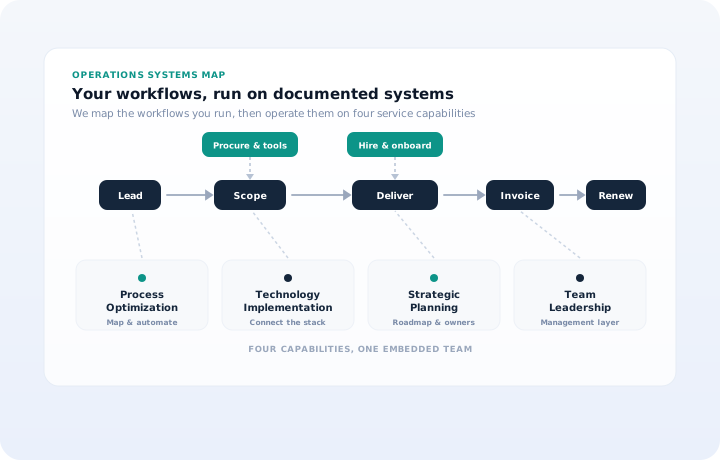
Approvals and exceptions have owners, so you stop being the fallback for everything.
Deadlines land because somebody owns them, not because you chased them.
One place for each piece of information, and the duplicate entry stops.
Documented processes and clear ownership, which is exactly what a buyer looks at.
Every engagement starts by understanding where you are. From there we scope the model that fits.
Scoped. Fixed price. A defined outcome.
Best when there is one problem to solve: a process to redesign, a tool to implement, or documentation to put in place.
Embedded. Hands-on. Month to month.
Best when the workflows need continued attention, and owners, approvals and cadence have to keep up as the business changes.
Send a short message or book a conversation. You do not need to choose a service first.
Discuss your priorities and receive a proposal with clear responsibilities, deliverables and fixed fees.
Begin with the work that matters most, with a clear point of contact and a practical next step.
Fixed monthly fees, agreed before the work starts. The estimator on the pricing page builds a number for your business.
Ranges, not quotes. Your fee is fixed in the proposal and depends on scope, volume and the state of your records. Above $20M in revenue we scope individually.
See pricingThe analysis comes with the service, and a person walks you through what changed and what to do about it. See what the client portal includes.
Real activity: hundreds of referrals a year and real closed business, all of it happening outside the platform that was supposed to be the system of record. Three pipelines that overlapped, one of them left over from a single event. Over a hundred custom fields, most auto-named duplicates. Payments connected and no products configured, so no money moved through it. A member portal with nothing in it.
Every pipeline, workflow, form, field, tag, calendar and integration listed, with what each was actually for and whether anything still used it.
Registration, attendance, application, payment, review, onboarding and renewal as a single path, instead of three partial ones that disagreed.
The rebuild happened in a safe environment and went live once it had been tested end to end, not incrementally on top of the account people were using.
One pipeline per real stage. The stages match what the organisation actually does, so an opportunity sits in one place and means one thing. This engagement is anonymised: real situation, real work, and the figures that would identify the client left out.
Most engagements use more than one of these, and they are built to fit together.
Financial leadership for the decisions ahead.
Add senior oversight to the monthly close and reporting.
Keep the books current and close each month with confidence.
Clean books. A clear baseline. Ready to move forward.
Tell us what you are working through. We will help identify where to begin.